
4.09.2009
So, last night I was scouring the internet for a great interview with Lux I read years ago, in which he makes the very legitimate complaint that as punk rock is being canonized for history in books like PLEASE KILL ME and movies like Don Letts' PUNK: ATTITUDE, The Cramps aren't there -- despite the fact that they played CBGBs and Max's ALL THE TIME. I finally needed to use the "wayback machine" to dig it up. Since it's no longer on the net, I feel morally justified putting it up in its entirety. I also found an additional interview with Lux and an amazingly candid interview with Ivy about how hard it is to pull off "basic" riffs -- again, showing how much "smarter" and more "technically proficient" bands still manage to get it all wrong!
Since I don't want this just to be reprintsville, I'll add my own personal anecdote. To be a good musician, it seems you first must be a fan... which is why it was so oddly impressive when, at one of the Hootenannys a number of years ago, Lux, after turning in a breathtakingly unhinged performance that left his latex outfit in tatters, could clearly be seen in a Hawaiian shirt and black jeans, standing next to Ivy, grinning as he watched THE REVEREND HORTON HEAT with the enthusiam of a 15 year old kid. It was an unguarded glimpse "Erik Purkhiser - music fan" who was the brains and heart behind the stomping, crawling, flailing id of "Lux Interior" that just amped my already considerable appreciation for the band.
Okay, on to interviews by others:
The Cramps
An interview with Lux Interior
& Poison Ivy
By Frank Reese
“ATTENTION” called LUX INTERIOR, “It seems that Y2K bug has struck in the form of what many are calling a ‘computer fluke’. Due to this technological ‘glitch’ you can only receive one TV station.” As he leafed through the couch potato bible, the TV Guide, he deadpanned like the best seasoned comic, “3:00 AM, ‘Bob & Carol & Ted & Alice & Turner & Hooch”. What followed was the most bizarre movie treatment this side of FELLINI on LSD25.
As LUX delivered the punchline to this unhinged synopsis IVY banged out the chords to “TV Set”.
Yes, the millennium is here and thank god so are THE CRAMPS.
THE CRAMPS are a band that have eluded my tape recorder for far too long.
Practically every tour for the past few years I have tried to set up an interview with them, but as always I ended up running into a wall of resistance (inept promotions people, not being able to keep up with their “label jumping” and just plain bad luck)
THE CRAMPS define everything that is great about rock’n’roll, period.
LUX is like no performer I have ever witnessed in my life. The music seems to totally derange his psyche to the point-of-no-return, summoning some ungodly spirit of rock’n’roll and possessing him to bend micstands over his head and practically swallowing the mic itself in the process. By the shows climax of “Surfin’ Bird” he is usually half naked, straddling atop the PA system, shouting incoherently to no one in particular to the accompaniment of the beautifully chaotic wall of guitar feedback delivered by the lady herself, IVY.
The current lineup is of course
LUX INTERIOR - vocals
POISON IVY RORSCHACH - guitar,
HARRY DRUMDINI - drums
and the addition of their newest member, SUGARPIE JONES - bass.
As New Years got closer it looked as though I would not get the opportunity to interview them. No one from the record company returned my calls so I decided to get to the club early and hopefully coerce the band into one. As i reached the door of the club, a worker was busy decorating for the evening’s event.
“Hi, I have an interview with THE CRAMPS”
“Oh yeah, go ahead, i think their upstairs”.
That was easy enough.
Snickering to myself as i climbed the stairs, it seems that they had just finished their soundcheck and IVY was signing a few autographs for the stagehands. I intercepted her as she made her exit.
Are there any New Year’s resolutions for THE CRAMPS?
IVY: Ummm... continue being perfect!
That won’t be too hard. What can we expect from the band this year?
I: A new record, we’ll be touring. SUGARPIE is touring with us now so that’ll be the first album that he’ll be on. What else?
LUX: We’ll also be working on a boxed set.
I: That’s set for 2001 but we’ll be working on that.
Who do you think will put that out?
I: Vengeance Records
Is that your label?
I: Yeah, it’s our label.
What’s the story with your website? Every couple of weeks i check it out & it still is under construction.
I: It’s not us, it’s a squatter. He put our picture up and it looks official but he’s been contacted... I understand that it’s a fan but we really need to do something ourselves. We’re attempting to take it over.
Are you into the whole internet thing?
I: Not at the present but we will do the website and sell our dirty underwear on it (laughs) Get money anyway you can.
What happened to your deal with Epitaph?
I: We weren’t happy there, so we told them we wanted to leave and had to make a deal with them, give up something that they owed us in exchange for leaving. The guy who signed us had left the label, he had some personal problems right after he signed us and the guy who took over really wasn’t a fan. Not a really interesting story, but that’s what happened.
So now you have a new bassist...
I: Yeah, SUGARPIE.
Who did he play with previous to THE CRAMPS?
I: He played in CELEBRITY SKIN, an LA band.
What happened to SLIM CHANCE?
L: We did a lot of albums with SLIM but it didn’t seem to be quite as much fun there towards the end.
You and IVY are the core writers, do the other members contribute ideas as well?
I: We write the songs but we certainly require a band effort.
How did you eventually hook up with SUGARPIE?
I: There was a series of auditions, but we met him through DONITA.
L: From L7
I: But we did audition a lot of people.
Do you feel as though you are part of the music scene in LA? The reason why I ask is because when you hear about the whole punk scene in New York in the late 70’s, early 80’s, you never hear about THE CRAMPS.
L: We never felt like we were part of that scene either, even though we played there, sold out shows once a month. We were never included in any of the write ups. Nationwide press but nothing from there.
Why do you think that was?
L: Well, I think they looked at us like we were a bunch of hicks (laughter) And they’re right, we weren’t a bunch of art students like most of them.
I: Ooooh, good one. (laughs)
When you come down to it very few bands were from New York, but they fit in. THE CRAMPS always seemed like the outsiders.
I: We’ve been like that all our lives.
L: People still continue to write books about that scene without including us like it never happened.
I was really disappointed that there wasn’t anything written about the band in the book, “Please Kill Me”, which was one that was quite good.
I: That’s true because we knew all those people, we were around them everyday. I think that you needed to die to make it in that one. (laughter) But here we are, not quite dead.
What ever happened when you submitted the demos for the JOHN WATERS film, “Crybaby”?
L: We were asked to write a few songs for the film. JOHN WATERS really wanted us and it turned out to be music business crap. He never even got to hear the songs. Somebody in LA was choosing the songs. Later we released the songs on the b-side of a record and somebody played it for him and he said
“I wish I would’ve heard this, I would’ve put it in the movie”.
It seemed like they were shooting for a very homogenized, squeaky clean sound.
L: Well, it was other people picking the songs. I think DAVE ALVIN was one of the people picking the songs.
You guys always look so great, I'm surprised that you haven’t been offered more film work.
I: LUX got offered a role in “THE CROW”, the one that BRANDON LEE got killed in. He tried out for the villain role but turned it down cause the script was completely different, really juvenile.
L: Well, I don’t know if it was completely different because i never saw it but it was all hardcore, just shit jokes and stuff like that and i couldn’t see myself in something like that.
How did you get the job of doing the “voice-over” screams for “DRACULA”.
L: FRANCIS FORD COPPOLA’S daughter liked THE CRAMPS. (laughter) She basically told him that she liked the way I screamed and so he called us. (more laughs)
I remember seeing an episode of “90210” that had THE CRAMPS on it. How did that come about?
L: JASON PRIESTLY’S wife wrote that episode and she also likes THE CRAMPS.
Did you enjoy that?
L: Yeah it was real easy. We spent one day there and it was kindda like playing a gig. We just played the song one time and walked off.
Are you still in contact with any former CRAMPS members...
L: We see KID CONGO pretty often cause he still lives in LA.
Did anyone hear from BRYAN GREGORY lately?
L: He lives in LA somewhere.
What’s he doing, anything musically?
L: Nothing
So all the rumors about him running a chain of adult book shops, a tattoo artist in Florida, weren’t necessarily true?
I: He lived in Florida before moving to California but he’s pretty... burnt.
What ever became of CANDY DEL MAR?
I: Well, she lives in New York and we kindda lost touch. She still does music, she was doing something with some of THE DEVIL DOGS.
Are there any particular songs that you really still enjoy playing, even from the early days?
L: We really like them all, there’s not one that really sticks out.
I: Well, “Human Fly” is for me. It was one of our first songs and it just blew my mind the first time. You don’t know how good of an idea it is until you hear it and it was like “Oh shit”. (laughs)
Any current bands that you enjoy?
L: No
I: Ummm... no.
When you toured in the early days you were on some unusual bills, playing shows with bands like THE POLICE...
L: They were real nice to us. That was a fun experience.
I: Yeah, there weren’t any horror stories. I guess since we were a band from New York they kindda treated us good.
L: There was a few pop acts that we toured with in Europe that we didn’t have much in common with but everyone kindda treats us ok.
Here's another great interview, seemingly lost in the sands of time:
THE CRAMPS - All The News From Badsville
Lux Interior interviewed by DJ Johnson
It's a well known story by now. Lux Interior (not his real name) met
Poison Ivy Rorschach (not her real name) in California as she was
hitchhiking. Of course, there's an equally well known story where
they met in a college class, but I like this one better because it
holds that Ivy was wearing jeans with a big hole in the backside,
through which Lux saw bright red panties and knew instantly that he'd
found his true love. You've gotta admit, it's a better story. I didn't
ask Lux which one was correct when I interviewed him one late September
afternoon, partly because I was afraid the boring college story would
turn out to be true. Instead, we talked about records, cars, soul, blues,
records, collecting stuff (like records), sexploitation flicks, sex in
general, and the music on Big Beat From Badsville, the latest LP/CD from
The Cramps. Most everyone knows at least something about The Cramps, so
we'll dispense with the intro and jump right in.
* * *
Cosmik: You have new digs since your last album. How did you end up with
Epitaph, a label known for high-speed punk?
Lux: Well, they put out our last album on vinyl because we were on
Medicine Records, who is going through Warner Brothers, and they
don't do vinyl because they think it's an ancient thing of the
past. So Epitaph contacted them and said "you're not putting
it out on vinyl, at least let US put it out on vinyl." So they
let Epitaph put out Flame Job on vinyl. We met them at that time
when that happened because they were bringing us test pressings,
and we got to know them then and really dug them. They all seem
like real people as opposed to some of the people we were dealing
with at Warner Brothers. Then Medicine Records went out of business
and we just went straight to them.
Cosmik: What's your general opinion of that type of music, the stuff that's
most commonly associated with Epitaph?
Lux: I don't know, I'm not too familiar with it. I'm not too into what
you'd think of when you say "punk rock." I mean, everybody's got a
different idea of what punk rock is. I think of it as what was going
on in the Bowery when we started playing, but the fast melodic punk
rock that's coming out now... I think it's great, I think it's a good
thing, and it's doing its job for a lot of people, but I don't listen
to it too much. Although they've got quite a lot of good stuff on that
label, and they've got another label called Fat Possum that's got an
amazing record by T. Model Ford, which I really love.
Cosmik: Yeah. I love the R.L. Burnside, too. That raw blues.
Lux: Uh huh. I just like rock and roll, and that kind of punk rock stuff,
it's more of a pop music. I could dig going to a club and being there,
but I don't sit at home listening to it.
Cosmik: Do you think the label "punk" ought to be retired at this point
because it doesn't really mean any one thing?
Lux: Yeah, cuz I don't really know what it is. Actually, I'd consider what
Epitaph is doing to be punk rock. It's kinda like... we started that
term "psychobilly" when we started in the spring of '76, we were advertising
ourselves as that and saying that's what we did. To us, it was a mixture
of garage punk from the 60s and rockabilly and all that, and all the things
we do. Later on, it became... There is a thing called "psychobilly," which
is real fast, 90 mile an hour rockabilly-flavored punk rock, and I don't
think we're that. I think the same thing's happened to punk rock. It's
become something different from what it was originally, and so what people
think of as punk rock now is not the same thing as what I thought of as
punk rock for years.
Cosmik: Ask any three people what punk rock is and you'll get three different
answers.
Lux: Oh yeah. I like William Burroughs' definition the best. He said "I
always thought that a punk was somebody that took it up the ass." (Laughs)
Cosmik: {Laughs) Never heard that one, but it works. Have labels tried to
change your sound in the past?
Lux: No. Nobody has, that I can think of, outside of a casual remark or
something about this or that. They've never really attempted to say
"I want you guys to do this or that..."
Cosmik: ...to make you more commercial.
Lux: Yeah, you know, there've been some really timid attempts, but I think
we just appear too crazy to try and even get started in that direction.
Cosmik: So sometimes your scary personae will come in handy.
Lux: It has! A lot of times people will come to see us, people from
record companies, and they're supposed to come back later, and they
don't. They'll say "I was too freaked out! I saw your show and I left."
So that's good. It keeps away the evil spirits.
Cosmik: The new album is just what we all expected: another batch of
great Cramps tunes. I don't think there's another band that's
been doing it as long as you that has stayed faithful to their
original sound and vision. How have you been able to do that through
all the personnel changes and with all the changes in the sounds
around you?
Lux: Well, you know it's just basically that me and Ivy have always written
all the songs, and we had the idea for this band before we'd even HAD
any bands, because we were going to see other people in bands. That
really doesn't change. We still listen to a lot of the same old records
that we listened to back then, so it seems perfectly natural to us. We
just like rock and roll. It's no effort to keep doing this. It would
be an effort to do something else cuz this just seems like the bullseye
of what's fun and what gets us out to an exciting show in a town near
you.
Cosmik: Are you a soul music fan?
Lux: Oh yeah.
Cosmik: You know the old "answer records," like "Work With Me Annie," and
then Etta James answered with "Roll With Me, Henry," and then somebody
came up with "Annie Had A Baby..." I noticed you've continued the legend
of Sheena. "Sheena's In A Goth Gang Now" is punk, but there's some R&B
in your approach to some of your tunes.
Lux: It's strange; no one ever comments on it. Everybody says we do
garage punk and psychedelic and rockabilly, but there's all kinds of
60s and 70s soul in our songs, too, and definitely rhythm and blues,
and blues. "Can Your Pussy Do The Dog," you know, that was just like a
60s soul song. Most of our albums have that influence, but it seems like
nobody ever brings that up. We love soul music.
Cosmik: Most bands make their influences obvious from song to song, but you
seem to have distilled a lot of different influences into a very consistent
single thing, so I wonder if maybe a lot of people can't actually hear
the R&B or any of the other influences anymore, like they just hear "the
Cramps' sound."
Lux: Yeah, I think a record collector, somebody who just can't get enough
music and buys all kinds of music and listens to it, would hear it, but
most people wouldn't. Led Zeppelin was a band that came straight from
the blues. You listen to what they did in the 70s, and most people would
think that was totally original and didn't come from ANYWHERE... but it
did. And it's the same with most other bands.
Cosmik: I want to ask you about the imagery in some of your music. "Monkey
With Your Tail," for instance, is another hot dose of animalism, which
is one of the aspects of your music that fascinates me. What is it about
that aspect of human nature that draws you?
Lux: You know, I can't really give you an honest answer, cuz I ain't got
one. It seems like that comes up a lot in the records we listen to.
A real rock and roll song, I think, is about sex most of the time. So
that leads you to "I Wanna Be Your Dog." That's one of the things that
a lot of people would like to pretend, that human beings are above
being like animals. We kind of enjoy that idea, but that that's what we
are: one more animal.
Cosmik: And the best sex is animalistic?
Lux: Yeah, well, sex is pretty animalistic, I think. It can have more than
that, but that was definitely part of the blues, kind of an attack on
that idea that now we're cultured, civilized people and we're above that
kind of thing. Seems like the blues has always been about "no, we're not
above that kind of thing."
Cosmik: The monkey sounds in that song are great. I have that song on a
tape segued from "Wild Women Of Wongo" by The Tubes, by the way. Killer
segue.
Lux: I've seen The Tubes several times now, but I saw them before they had
any records out. They were opening for The New York Dolls right as The
Dolls' first record came out in San Francisco. We were not expecting
anything. It was just a band named The Tubes, you know? It could have
been anything. It could have been four guys with beards come out and
and play violins, you know? And out came Fee Waybill with these two-foot
high platforms. We weren't ready for it at all. They were amazing, and
then The New York Dolls came out and they were amazing, too.
Cosmik: Man, I don't know if I could stand a double header like that. I'd
be too hyped.
Lux: I remember that night David Johansen (NY Dolls singer) came out wearing
a T-shirt that had a picture of Marilyn Monroe on the front... It was
like a black and white picture, and he had painted her hair blonde and her
face pink, and then he put lipstick on her lips. Then when he started
sweatin' about the fourth or fifth song, her lips just ran down his
stomach. (Laughs)
Cosmik: What a cool thing to see! The Tubes, and maybe sometimes The Dolls,
had a certain level of camp in their performances. Do you think there's
an element of that in your show?
Lux: I would say The Tubes were a more theatrical group. We don't do anything
very theatrical except be ourselves. You wouldn't call The New York Dolls
a theatrical kind of group. They were just an R&B band that came out and
played as themselves, and that's kind of what we do. We don't have props,
but it's definitely entertaining.
Cosmik: Most of your sex songs are about danger in one way or another. The
image of woman as predator. Does sex without danger bore you?
Lux: Well, geez, I think just about any sex is exciting, but it's even more
exciting if there's a little danger involved, I'm sure.
Cosmik: Your music... the sound of it... is dangerous, too. Put the imagery
with the sound and you're probably the most dangerous sounding band of
all time. What kind of resistance have you seen from churches or parent
groups over the years?
Lux: Oh, some people are really upset by us and go to great lengths to try
and do something about it, but it's never caused us too much of a problem.
Except that we've missed out on opportunities because of it. We've had
the cops come, like in Florida, cops come to watch and make sure we don't
get out of hand. Florida's pretty back there, and always has been, for
some reason. I don't know why that is.
Cosmik: Aw, they're just still mad because Morrison died and got off the
hook.
Lux: Yeah, they're lookin' for somebody.
Cosmik: Let me throw a quote at you, one you know well... "Each one of us,
in his timidity, has a limit beyond which he is outraged." Of course,
the quote goes on toward analyzing public attitude, but...what are
YOUR limits? What are you outraged by?
Lux: What outrages me is that people can be so satisfied and half asleep.
I don't want to go back to the 50s or something, but I do remember a time
when cars looked like rocket ships, and people wanted to have a wild time
and dress sexy and dance sexy and try new, crazy things. It seems like
these days there's an abundance of boringness and timidity, and that's
the kind of thing that outrages me, you know? Boring people, that's
nothing new, but the numbers are growing rather than going down. It's
not a good sign.
Cosmik: What is your life like? I mean when you're not recording or touring.
What do you like to do when there's no claims on your time?
Lux: We have a huge collection of old horror comics from the 50s... And I
have 80-some old 3-D cameras; I do a lot of 3-D photography. That's
a passion of mine. I watch Ivy prance around the house in fabulous
sexy outfits...
Cosmik: Not a bad life!
Lux: No, it's great. I can't think of any way to improve upon it. We have
a huge record collection of 78s and 45s, and we play that stuff all the
time. We have a huge collection of sexploitation videotapes, like the
stuff Something Weird is putting out. [Ed.Note: Something Weird is a
Seattle-based video company. Call 206-361-3759 or visit their website
at http://www.somethingweird.com/.] We're involved in the custom car
thing that's happening here in LA, and we go to a lot of that stuff.
We have a '56 Dodge.
Cosmik: Wouldn't happen to have a flamejob on it, would it?
Lux: Actually, it doesn't. We want to get some other cars, but we don't
have anywhere to park them right now. I don't have the heart to put a
flamejob on this one because when we bought it, it only had 38,000 miles
on it and it was like brand new. We got it for like $1,500. I'd rather
buy something that's a little bit more of a junker, because if it's junky
you don't mind stripping the paint and customizing it and putting flames
on it. But not this one.
Cosmik: It would feel like sacrilege?
Lux: Yeah. It's stock. Except that we put leopard-skin seat covers in.
That's the only thing that's not stock. It's pretty amazing to have a
completely stock car from 1956 that's so new. You don't wanna mess that
up.
Cosmik: Do you turn your own wrenches?
Lux: Oh, it depends. I spent my life fixing cars, but lately I just don't
have the time. When something goes wrong with it, unless it's something
pretty easy to fix, I'd just as soon let someone else do it because I
just don't have the time anymore.
Cosmik: Trying to picture you working on an engine...
Lux: Oh yeah, I've done that all my life.
Cosmik: So you were into the car club scene?
Lux: Yeah. Back when I first started buying cars, I'd always buy 'em, they
wouldn't be running, and I'd have to put a new engine in 'em or something.
I'm pretty much... I'm about a half-ass mechanic, I'd say. Course, I
couldn't work on one of these cars today, but the old cars I can. You
open up the hood on these cars today and it looks like a computer.
Cosmik: It's not like anything you'd be proud to drive, anyway. I still
dream of having a '57 T-Bird. Someday I'll have it.
Lux: When I was a kid, I used to say "someday I'll have one," and I hate to
say I still haven't got one, but maybe that'll happen before they throw
me in the box.
Cosmik: What, you mean a '57 Bird? You wanted one, too?
Lux: Yeah, or a '55 or '56.
Cosmik: Cool. Those were great cars. Let's shift gears a bit here and talk
about your record collection, because I know that's one of your biggest
passions. You've been at it a long time now.
Lux: Yeah, actually my brother was a real juvenile delinquent in the 50s, and
he had an amazing collection of 45s. At one point he decided he didn't
want them anymore and he gave me this huge collection of his stuff. That
was in the early 70s, and music was really boring at that time. When I
met Ivy, we were discovering all these rockabilly records in junk stores
in Sacramento. Ever since then we've been record collectors, and we've
amassed quite a bunch.
Cosmik: What kind of space does the collection require at this point?
Lux: Oh, a bunch of rooms. More room than we've got, because they're
stacked up in boxes all over the place instead of being easily
accessible, but we've got some great stuff. We've got all the Sun
Records 45s and 78s, except for a few. There are like maybe 6 or 8
of the early blues numbers that we don't have.
Cosmik: Whoa, so you're saying you actually own almost everything ever
put out by Sun?
Lux: Yeah, we have over 200. When me and Ivy first met, we had an old '61
Chevy station wagon, and we heard that you could still buy Sun Records
in Memphis, so we drove to Memphis from Sacramento. This was in 1972.
You could buy Sun Records at six for a dollar at Selective Hits, which
was the Sun warehouse. So you could buy "Flying Saucers Rock And Roll"
by Billy Lee Riley for 18 cents. We went in and bought boxloads of them,
kept one of each, and used the rest to trade for other stuff. When we
lived in Ohio it was especially amazing because we'd just find unbelievably
rare things. All the southerners would come to Ohio to work in the
Steel Mill and the rubber companies in the 50s and 60s, and they brought
their records with them that never made it out of the south, and they
ended up in the junk stores around Akron and Cleveland. We went in there
and got that stuff. We got stuff like the Teen Kings record... it's
Roy Orbison's band, before he was on Sun, doing "Ooby Dooby." It's a
different recording. There were only about 300 [pressed], and we found
one of those. We found all these unbelievably obscure records. We've
been doing that for 25 years or something, so we've amassed a lot of
them.
Cosmik: Did you ever go through the business of cataloging all that?
Lux: We have them in alphabetical order, like we have all the rockabilly
in one place, all the rock and roll instrumentals in one place, all the
surf instrumentals in another place, R&B in another place, blues, you
know...
Cosmik: With all of that, it seems like you'd be overwhelmed by choices.
How do you even decide what to listen to?
Lux: Well, over the years you get to know them just like they're friends.
Like friends you have on your mind, and you think "oh, I wanna listen
to that," and you just go grab it. When you've got a LOT of records,
it's more fun, because you can just go looking through them, and you
always find something that you don't remember what it sounds like, and
you rediscover something you haven't heard in ten years.
Cosmik: So if you're in the mood for Little Walter, you might find yourself
listening to Charlie Musselwhite?
Lux: Uh huh. I think we've got a pretty good selection. When we first
started out, it was collecting the vocal groups from the 50s, like The
Orioles and the Castelles, and all these weird R&B vocal groups that
would do the real slow stuff, you know, the stuff that's even slower
than doo-wop. The slow, dreamy, druggy kind of stuff. As we were doing
that, we just ran into rockabilly by accident. We'd buy some record, put
the needle down, and we'd say "I wonder what THIS sounds like?" And it
would be some guy going "HYAYAYAYAYAHH!!!" And we'd go "My GOD," you
know? And that's when it first dawned on us, I think, because we were
thinking we wanted to have a band. We'd go see all these bands and we'd
be thinkin' to ourselves "boy, it would be cool if WE had a band," and
then it dawned on us because of some record we brought home, "geez, we
could play this stuff." There were all these bands, like The Rolling
Stones and The New York Dolls, that took R&B and did something with it,
but nobody had really done anything with rockabilly yet. We thought that
would give us a real head start, that we'd have some resources to do
something that came from the blues but hadn't been done yet.
Cosmik: Hey, when you drove away from Selective Hits with all those Sun
records, did you feel like you'd just robbed Fort Knox?
Lux: Oh, yeah! Oh, man... And they not only had Sun records, but they had
stuff from a lot of other labels that were there, too. It was just
amazing. Then when we went to Ohio... We basically went there to get
jobs to buy guitars, because we were on our way to New York, to CBGB's
and everything, because we knew we wanted to have a band. When we got
to Ohio we found there was a place THERE selling Sun records really cheap,
too. They had done the same thing. They had bought a bunch of records
earlier at Selective Hits in Memphis, and they were selling them for a
dollar to five dollars, and the really rare ones were ten dollars.
Cosmik: Which is still one hell of a buy.
Lux: Yeah, oh... I can't even imagine what the really rare records are going
for these days. But that's what's great. These days, you don't have to
have it that way. You can buy reissues. Back then, there was only one
way to get that stuff. You had to find it somewhere, in a junk store or
something, you just had to discover it. Which was the more FUN way of
doing it, but I'm really thrilled that all these reissues are out now so
people can hear it all. We talked about it for a long time when we first
had a band, you know, and people would say "50s music? You don't sound
like 50s music!" People had no idea of the great music that had happened,
rockabilly in particular, just because none of it had been re-released.
Outside of Jerry Lee Lewis and Elvis, you know, there wasn't much that
anybody had even heard. It was pretty obscure stuff. Then when all these
reissues started happening, people became aware of this amazing heritage
of great American music that nobody knew about. Which is really good.
You know, it's just music. People shouldn't have to pay 100 dollars for
a record. It's insane.
Cosmik: Agreed. You know, I'd never heard Charlie Feathers until Charly
Records put out some Sun compilation CDs. Hearing him was such a
revelation.
Lux: Oh, he's my all-time idol. He's just really amazing. Sun Records,
in particular, you know just about anything you buy on Sun Records has
gotta be pretty good. When we recorded at Phillips Records in Memphis,
Sam Phillips came walking into the place, and that was a real amazing
shock. He was covered with grease all over his hands. The hedges had
grown up over the sign in the front, and he was out cutting them with
electric hedge trimmers, and the thing just exploded all over him. So
he was covered with grease, and we all grabbed him and we were shaking
his hand, getting grease all over ourselves! (Laughs)
Cosmik: "It's okay, it's Sam Phillips grease!" (Laughs)
Lux: Yeah, boy, I said "we have almost every record that you ever made here.
Almost every 45 and everything." And he looks up and he goes "Well, y'know
what? You're lucky." (Laughs)
Cosmik: Damn straight! What are some of the prizes of the collection, not
necessarily in terms of market value, but in terms of how big a buzz it
was to find them?
Lux: Lemme see... We found Vern Pullens doin' "Bop Crazy Baby" on Spade
Records, which there are probably only about a hundred of... There's
one that we have by Hank Davis called "Women Train." He has a new CD
out that's really great, and he left that one off. It was the only one
he left off... probably because he thinks it's sexist these days. But
that was a great rockabilly 45 that we found. We've got "Hot And Cold"
by Marvin Rainwater, we've got all the Charlie Feathers singles... We've
got quite a few things from Star-A-Day Records. Those are really great,
all the Star-A-Day stuff... I dunno, I could go on and on about this.
Cosmik: What are some of the records you always look for but never find?
Lux: Well, I really would like "Indian Rock" by The Linn Twins. We've got
one record by them, but this one is like... WAY out there. It's like
"Love Me" by The Phantom, or something. I've seen one copy of it, and
the guy wouldn't sell it.
Cosmik: Is this a rockabilly?
Lux: It's rockabilly, but it's way beyond that, even. It's rockabilly
from outer space. Really archaic, wild, out of control thing.
Cosmik: Is your record collecting habit and your affinity for collectors
partly responsible for the number of singles and EPs you've put out for
each album?
Lux: Oh yeah. To us, the 45 RPM single is... We tend to think in terms of
songs and not albums anyway, so when people say "this is your best album,"
or "I don't like this album as much as that album," I never even know what
to think of it because we think in terms of songs. I'm sure if someone
said "I don't like this song as much as that song," I could start to think
about that. A single is usually the best thing on an album, anyway.
Cosmik: Do you have any use for CDs, or see any hope for the format as a
collector's item?
Lux: I don't know about a collector's item, but I think it's really great that
it happened. Because of that, a whole hell of a lot of music has been
reissued that would not have been reissued otherwise. One of the first
things that came out was that Robert Johnson box set, and it sold something
like 300,000 copies. A Robert Johnson set! If somebody put out a Robert
Johnson ALBUM, it would probably sell about 2,000 copies. But everybody
had new CD players and everybody bought that. I think that's amazing.
Anything that can make people buy a Robert Johnson record, well it's a
good thing.
Cosmik: Are you particularly fond of Halloween?
Lux: Oh yeah, it's always a special night for us.
Cosmik: Are you playing anywhere this Halloween?
Lux: Yeah, in San Francisco. Played there last year, too. We like to play
there on Halloween because they like to dress up insane and go all-out.
Cosmik: When you do shows on Halloween, do you do anything different than
usual, or is usual different ENOUGH?
Lux: That's the one night we dress up... like I'll wear a dress or something.
We're not just the "normal Cramps" that night. Last year our drummer went
as Elizabeth Taylor. [Laughs]
Cosmik: You've been doing this a long time. Do you ever get burned out on
it and want to call it a day?
Lux: Oh, no. It's the funnest thing we do. It gives us energy, it doesn't
take energy.
Cosmik: What's in the plans? What's next?
Lux: Well, we're touring America in a couple weeks, and then we go to Europe
and do a lot of touring... Then after that, we've got some ideas for things,
but I don't wanna say anything because half the time you say something it
doesn't happen, and you're left saying "How come THAT happened?"
Cosmik: [Laughs] Hey, I understand. I'm a big believer in "the jinx" myself.
Well, I've just got one more question here, but it's a long one...
Your music reflects a different culture than most people have been
exposed to: surreal art, trash novels, b-movies... If someone, let's
say someone reading this interview and getting curious about The Cramps,
was going to prepare to listen to your music for the first time, what
would you suggest as a prep course? What would be the perfect films,
books, paintings, etc, to absorb before turning up The Cramps?
Lux: I'd get some 50s horror comics. The kind that were extremely gruesome
and sexy. The kind that inspired them to write that book, The Seduction
Of The Innocents, that talked about how our youth was being destroyed by
comic books. That's one of the first things that happened in the 50s that
led to the youth revolution of the 60s. I'd tell people to buy some
reissues of old rockabilly records, or any kind of real great rock and
roll records. Get some of the sexploitation movies that Something Weird
Video is putting out on video. There's a huge wealth of these sexploitation
movies that people don't even know about yet, and they should. It's a
real important part of Americana. It's a whole world that exists that is
still yet to be known.
____________________________________________________________________________
POISON IVY RORSCHACH - Talkin' Axes & Amps With The Queen Of The Cramps
Interviewed by DJ Johnson
"This is Ivy. Lux said you had guitar questions?" I was more than a little
surprised, and anything but prepared. I had finished up my interview with
Lux Interior only an hour or two before, and I was already transcribing from
tape when the phone rang. Being the suspicious type, I had figured Ivy
must have blown off the interview because she'd heard all the questions
before anyway. Let's face it, The Cramps have been making great rock and
roll records for two decades. That's probably several thousand interviews.
Who could blame her for getting burned out on the whole process. But here
she was, apparently anxious to talk about one of her favorite topics.
Poison Ivy Rorschach once said she admired anyone who declared themselves
king or queen of their own little world, or words to that effect. She never
had to declare herself queen. It was an unspoken fact acknowledged by all
who witnessed The Cramps in performance. As the Gretch-slinging,
garter-wearing head mistress of rock and roll, Ivy has probably been lusted
after more than any other woman in the biz, and it's unfortunate that the
public perception often stops right there, because behind the sex goddess
image there lurks a mighty fine guitarist.
In recent years, Ivy's playing has finally been mentioned favorably in
various guitar publications, but the press in general almost seems to be
unaware that she even plays guitar at all. This is somewhat perplexing
to Ivy, but then she's certainly no stranger to sexist attitudes, and that
is most likely the root of the matter. We began with that subject.
* * *
Cosmik: Ivy, your playing on Badsville is hotter than ever, and I talk to
players all the time who list you as an influence. Not bad for someone
the critics said "couldn't play." Are you surprised to find yourself
getting that kind of recognition?
Poison Ivy: Yeah, it does seem like I'm getting it on this album, though
I'm still surprised how little I... Like I've gotten recognition, like
from Guitar Player [Magazine], and this and that, but like you mentioned
that you thought I must get tired of answering guitar questions, and
NOBODY ever talks to me about music or guitar. It's actually weird
that they don't. They say stuff like..."Lux's sidekick." [Laughs]
What am I, Igor going "Huhuhuh, Lux, let's play 'Surfin' Bird'" or
something?
Cosmik: Do you resent that a lot?
Poison Ivy: Well, it's just kind of weird, because they'll also say we're
sexist, but they won't even comment on my playing as being unique, which
I find pretty sexist.
Cosmik: It seems like there would be a paradox there, because the way you
dress on stage would invite sexist attitudes, but the danger in your
persona would make a lot of people afraid to approach you that way.
Poison Ivy: It does. Yeah, it does. No, I don't have problems. Some
other band, some female guitar player, said she got hassled, but I don't.
I guess I look like I would dish it back.
Cosmik: It just seems to me that you would scare them away from doing that.
Poison Ivy: I think we even get the kind of fans that wanna BE scared by us.
Cosmik: I can tell you really love the key of E...
Poison Ivy: I do.
Cosmik: Powerful chord, isn't it?
Poison Ivy: It is. I also love D. I love the D to E thing a lot. Something
about going back and forth from D to E. Isn't that strange how if you
change key, it doesn't seem the same? Cuz I know that color... like in
sound and color there's supposed to be different frequencies, like a higher
octave of sound is supposed to manifest in colors like green or red. That
must just be something that you hear in a different chord. Yeah, I love
E. I also love E because I like doing a lot of open things.
Cosmik: Like open string stuff, riffing and all that.
Poison Ivy: Yeah.
Cosmik: And you can obviously also kick ass in other keys, but it seems
like even the songs in other keys touch on E somewhere in the meat of
the riff. "Monkey With Your Tail," for instance, which is in F-sharp.
Poison Ivy: Yeah, I don't know why, I just always feel it's like home. It's
like headquarters or something. [Laughs]
Cosmik: It's your anchor.
Poison Ivy: It must be. Cuz you're right, that song starts in F-Sharp and
then goes back and forth on E. It's also partly to do with the keys the
singer sings in. Which I think a lot of bands don't bother to do that,
to play in good keys for the singers, because with a lot of bands, it's
the singer that keeps me from liking the band. We'll always try like
10 different keys until we find one that's just in the pocket for the
singer. I wonder if some bands do that, and I think they should consider
it, because with a lot of these bands I think the guy can't sing, but the
band's just not finding his key. You know, it helps.
Cosmik: On a lot of the indie punk records I get, the singers are just
struggling.
Poison Ivy: I think it's like every man for himself. They don't think "maybe
we should move that or adjust that." That's one thing we always do. We
always experiment. Lux has a pretty good range, and he can sing things
in different keys, but sometimes a song just sounds more exciting if he
sings it higher. Or just the opposite; depending on the nature of the song
and the tempo, it might sound more sinister if he sings it low. So we'll
rehearse it in like three different keys, and they'll all have different
feels to them. Even if he can sing all of them, maybe one of 'em, he's
straining his voice, and sometimes straining his voice makes it sound
more exciting, so we'll go with it. So we experiment a lot. I think we
work harder than some bands in that department. Doesn't sound like it.
The way it comes off, they say we have simple boneheaded songs that don't
evolve, but there's a lot of work there.
Cosmik: Yeah, but they say it because it's not glossy.
Poison Ivy: I think it's like a cultural slur. When someone is from outside
a culture, they'll say "all that music sounds alike," or "all those people
from that culture LOOK alike," because they're not tuned in to all those
subtleties. To a lot of people blues all sounds alike. I'm not tuned
into the subtleties of reggae. I know there's a lot of it there, but it's
just not my world. Or hip-hop. It's just all different for different
people, and they should at least acknowledge that maybe they just don't
know instead of criticizing. Maybe it's better just to back off and say
"I don't know that."
Cosmik: I can't tell you how often I end up defending reggae to people who
don't even know where Jamaica is.
Poison Ivy: Yeah, and any kind of music, you have to really be into it, and
you have to figure if you're NOT into something, it could be because you,
the listener, haven't really jumped into that world or that culture. There
are types of music I like that I won't attempt to play or be influenced by.
I like music from India, but it wouldn't be authentic if... I mean, how
could I begin to be influenced? It's so culturally different. So I'm
going to play what I think I can play authentically.
Cosmik: And would it even work in the context of The Cramps.
Poison Ivy: Not right now. I mean... [laughs] that might take about 50 years
to incorporate it into the music.
Cosmik: Then again, The Cramps just might BE there in 50 years. [Laughs]
So for now you continue to explore the power of the open chords and
rockabilly and punk. I'm guessing that you're fond of Link Wray.
Poison Ivy: Oh, I LOVE Link Wray. Still. He was initially my biggest
influence, and he still is. I hear more and more. No matter how long
I've been doing this, I hear something new when I listen to him. Maybe
because I'm not the same person, maybe I know more from playing longer.
It enables me to hear more now, so it seems like I'm always hearing
something new and getting influenced by some new aspect of Link Wray.
He's just so... it's like guitar at the end of the world. So austere.
And so much drama. You know, he makes the most out of the least, for
sure.
Cosmik: So many guitar players follow the path of the intricate melody, which
is fine, whereas it seems your focus has been the power you can get
out of the open strings, and just finding the guts, the balls of an E
chord, which is why I asked you about Link.
Poison Ivy: Yeah, that's probably what made me aware of it or tuned me into
it, because my favorite guitarist is Link Wray, and I guess the thing I
like in what he does is what I wanna do, too. I just like hearing a lot
of strings splashing all at once. And just the austerity and the starkness
of how he plays, you know? The drama that's created by not overplaying.
Cosmik: Exactly. Which is still the number one crime committed by the average
guitarist, in my opinion. With all these songs in E and A, how do you
manage to keep it fresh and dangerous sounding where so many other
players can't?
Poison Ivy: I don't know. And I appreciate you saying that, because some
people would say that we just keep doing the same thing over and over,
which I don't think we do. So that means you're tuned into the subtlety
of it, which is great. I don't know... We collect a lot of records,
and I just hear a variety of things done in that key on those records.
It's kind of a weird form of meditation, I guess, because meditation
means just focusing on one thing for a very long time and finding all
the different layers of it and all the different things you can get out
of it instead of flitting from here to there. It's like "what ELSE can
I wring out of this chord? Is there another way to attack it?" But I
have a lot of inspiration. There's just such great stuff on records, so
there's always somebody to [listen to], and there's an infinite amount
of ways to play even the most cliched rock and roll. There are just so
many angles. If what I do is fresher than what others do, I don't know
what it is, unless they're just not listening to enough records to get
inspired.
Cosmik: I think it goes back to not knowing when not to play, too. I listen
to "Cramps Stomp," and there's so much power from chords just tailing off,
just hitting a chord and letting it snarl and sneer.
Poison Ivy: It's a real joy to play 'em that way. I think some guitarists
get led into an ego thing where they want to perform in some technical
way, which even if you can it's not always the best thing to choose to
do. I still like the idea of playing for the pure euphoria. My favorite
thing to play, still, is rhythm. It's just so euphoric that I really
get high playing. Certain things I play don't even feel like it's me
playing it, and that's my favorite kind of playing. I think guitarists
can get caught up in trying to be recognized for something technical or
intricate that they're doing, but they lose the whole world of getting
high just from playing when they do that.
Cosmik: Is "Haulass Hyena" in the key of A with the tape sped up?
Poison Ivy: It's got shifting keys. It was really hard to learn it, in
a way, to remember where to go, and now I've got to learn it again
because we have to go on tour soon. So many songs, I've recorded
them and never played them since. I remember I got out every guitar
boogie record we had... there's like "Earthquake Boogie," "Guitar
Boogie Shuffle," the Larry Collins/Joe Maphis "Hurricane" and... I think
I got out like 10 different guitar boogie records and I thought "can I
cram all this into one song?" [Laughs] Our poor drummer, he's so good
on it, but boy, when we first wrote the song we were like "okay, when
this part comes you do like this, and then you stop, and then you..."
and he was just staring into space. But then they did it, and they
learned it pretty quickly.
Cosmik: They got it down. I was talking to Lux about the animal imagery
tunes, like "Monkey With Your Tail" is my favorite track on the new
album.
Poison Ivy: It's mine, but I don't know why. It's something really juvenile
about it that I like, or jungly, or primitive... I don't know what it is.
Cosmik: The beast within... The wild thing.
Poison Ivy: Yeah. I really love doo-wop R&B vocal group stuff. It kinda
reminds me of that.
Cosmik: Really? You're a doo-wop fan?
Poison Ivy: Oh, that's how we got into the record collecting, initially.
Vocal groups. Then we just discovered rockabilly and everything else
while buying that. It's still an influence, but it's an influence that's
not recognized because we don't sing harmony. I get guitar parts from
vocal harmony parts. We don't get ideas from regular sources. We'll
get ideas for guitar parts from the saxophone parts on a record. Things
that aren't obvious. I love sax, you know? We've never had one in our
band, but I love sax. I don't PLAY sax, but I like it as much as guitar
to listen to, like 50s rock and roll, the really obnoxious kind of sax.
Cosmik: The kind of sax with guts and balls.
Poison Ivy: Yeah, and like that baritone sax that sounds really dirty.
Cosmik: Tone that really vibrates ya.
Poison Ivy: Big Jay McNeeley... He's not baritone, he's alto, but he's really
wild. He's wicked.
Cosmik: I was talking with Lux about the kinds of sounds you've absorbed into
your music. With you guys it's all melted into a central sound so nobody
would be apt to say "oh, check out the R&B influence in this one," but it's
definitely there. There IS R&B. Like "Can Your Pussy Do The Dog."
Poison Ivy: Yeah. Oh, that and... "Ultra Twist" was totally like the Ike-ettes
and that kind of influence. I'm trying to remember which song on this
album is kind of like a soul song... Well, "Super Goo" went past that.
By the time we finished that, it got pretty schlocky. [Laughs]
Cosmik: I loved your version of "Peter Gunn" on the Del-Fi Mancini tribute.
(Shots In The Dark.)
Poison Ivy: I love the song "Peter Gunn," and that was an opportunity to do
it. I don't know if The Cramps would have had an excuse to do it. Aside
from just collecting records in general, we collect certain songs, and
"Peter Gunn" is one of them. With some songs, it's hard to find a bad
version. They're all really fascinating, but different. There are all
these cool but very different versions of "Peter Gunn," so I've just
always wanted to do that song.
Cosmik: I'm curious... What did you think of The Art Of Noise's version?
Poison Ivy: Well, I was about to say there's not a bad version, EXCEPT...
That one just didn't make it for me. And I love Duane Eddy so much, but
I just didn't see what... I guess it helped Art Of Noise more than it
helped him. But there are some songs that are pretty hard to screw up,
like that one, "Harlem Nocturne," and "Night Train." All the versions
there are are just usually pretty great, and I just wanted to add my own.
Cosmik: How did you get involved with the Del-Fi project?
Poison Ivy: We were at a friends house, and he said he was going to be doing
something for it. He had a list of what everybody was doing, and I was
pretty amazed that no one was doing "Peter Gunn," so I just said "Oooo!
Here's my chance!" Del-Fi seemed excited to have my track on there, too.
They seemed like nice people, and they're based in LA, too. So it was
easy to do.
Cosmik: I assume you collect surf records, also?
Poison Ivy: Yeah.
Cosmik: Did you get a little buzz from being on a label with so much surf
history?
Poison Ivy: Oh, definitely. That was part of why I wanted to do it. I used
to collect their records before we were IN a band, and I never thought I'd
have a song on Del-Fi! I mean, that's probably a silly thing to get
excited about, but I was even excited about having a record on RCA in
Spain. Most people would think "well, that's a major," but to me, it was
the label Elvis was on. "Wow, I'm on the label ELVIS was on!" So, yeah,
it was great. Del-Fi had a LOT of cool stuff on it.
Cosmik: Is that a major buzz for you, having been a collector all your life,
knowing that people are out there madly collecting all your stuff?
Poison Ivy: Yeah, it's weird. Some of the records are really collector's
items now.
Cosmik: I asked Lux about this, too. You put out five or six EPs and singles
for each album, and most bands don't do that. You guys make some of the
coolest collector's items out there.
Poison Ivy: Yeah, and then there's the whole bootleg thing, too, which is
vast.
Cosmik: Does that bug you?
Poison Ivy: Most of it does, because a lot of it is pretty bad quality. There
are some that are pretty good, but most of them aren't. And they retitle
songs because we have fans that'll collect everything. So they change the
title of a song, and our fans take the records home and... like they'll
call "Psychotic Reaction" something, like on one they called it "A Walk
Down Broadway." So the fans think "well I never heard them do THAT song,
I guess I'd better plunk down all my dough and buy this." Then they take it
home and it's "Psychotic Reaction." It's mean. But other ones seem more
fan oriented. Some are really slick and have bar codes, and you can tell
it's just there to hustle money, and then another one will be like a real
crazy looking fan thing by some psycho, and that's kinda more interesting.
Cosmik: [Laughs] That's a whole 'nother scary area.
Poison Ivy: Yeah, but it's kind of exciting.
Cosmik: You played without a bass player in the band for a long long time.
Was it hard to adjust to playing WITH a bassist?
Poison Ivy: No, it wasn't, because it evolved in a real natural way on A
Date With Elvis. We didn't have a fourth band member, and I had already
done that song, "Surfin' Dead," for the soundtrack of Return Of The Living
Dead. We were still between members at the time that we made that, so I
just made a wall of guitar and included bass. They said they wanted it
to be "real pop," but OUR notion of pop was like Phil Spector, not 80s
pop, so we put that Phil Spector thing, that kind of "bomp...bomp-bomp...
bomp...bomp-bomp" beat in there. Then, when we made A Date With Elvis,
we still didn't have anyone. Also, the bass I played with was a Dan
Electro 6 string, and I also played a little bit of Fender VI on A Date
With Elvis. I only played a real bass on one song. But I kinda dug it.
It seemed even more prehistoric, to me. It was simpler. It's kind of,
in a way, given me more space to go from chords to lead and whatever. It
hasn't really changed what The Cramps is. A lot of people think it has,
but Slim [bassist Slim Chance] still takes solos on "TV Set," and he plays
those breaks on "God Monster." That's the bass player, it ain't me. So
nothing's different. It's just a different octave. In a way, we're still
acting like a two-guitar band. He does very un-typical things for a bass.
A lot of the fuzz is on bass. The fuzz pedal immediately takes all the low
end out anyhow. So it really hasn't been much of a change. The place I
notice the difference is on rockabilly songs. It's given them more power.
It's nothing slicker. I've heard people say it's slicker. It's just that
you have an octave. With Brian Gregory and The Kid, we had them playing
bass lines on the guitar. They were playing everything on the 5th and
6th strings, just literally bass lines. Nothing's changed, in that way.
To me, it's just more primitive and prehistoric and heavy, and it just
evolved naturally.
Cosmik: Is gear a big issue with you? Are you into gear?
Poison Ivy: Yeah... Yeah.
Cosmik: What's your setup right now?
Poison Ivy: My 1958 Gretch Chet Atkins 6120. Usually I play several guitars,
but this is the first time I played a whole album with that guitar.
Cosmik: Kind of gave it a cohesive sound, too, didn't it?
Poison Ivy: Oh, it's a great sound. I record with small amps. You get a
bigger sound with small amps. I prefer that.
Cosmik: Like what?
Poison Ivy: Valco. Live, I play with vintage Fenders. 15 inch speakers.
Real simple and tiny. Small gear, big noise. Now, everything's miked,
so when you see the stacks it's all for show. It's got nothing to do
with the sound that's being made at all. You know, not that "show"
doesn't have its use, but that's all it is, it's just show.
* * *
We had run well past the allotted time for this interview, so I asked Ivy
if she'd do one more thing for me. I asked her to do a quick voiceover for
our online "radio" show, Audible Debris, that I could use as a segue into
Cramps tunes. After 45 minutes of conversation in which she sounded like
Ivy, the girl next door, it was definitely Poison Ivy Rorschach who quickly
said "Hi, this is Poison Ivy. Stay sick with Cosmik Debris." Look for The
Cramps in the coming month, because they may just slide into your town for
a while, and you wouldn't want to miss that.

Who here is bummed that they'll never see THE CRAMPS again?
While many obits were fawning with praise for the "craziness" of the Cramps (and Lux's performances), few people -- even the "fans" who toasted his memory, seem to really get what he was about. Lux was a giant vinyl-diving music geek who used every fiber in his being to kinetically pass that enthusiasm for primitive rock and roll on to as many people as he could in his too-short life.
Lux was like a giant transvestite Alan Lomax -- a musicologist par excellence. In thinking of a simple way to convey how much good old music The Cramps dug up and brought back to life, I figured I'd refer back to an amazing (now sadly out of print) 3 CD set called SONGS THE CRAMPS TAUGHT US (an obviously play on The Cramps' album, SONGS THE LORD TAUGHT US). The track listing of those CDs isn't even an exhaustive list of the tunes The Cramps either "adapted" or covered. It is a fair representation of the sonic palate of a band often written off as a gimmick band. Nothing could be further from the truth, as their music touches on country blues, garage psych, surf, exotica, "crime jazz", the uncatagorizable Hasil Adkins and rockabilly and country of every stripe. So as not to clutter this post, I've put it HERE.
For 300+ more examples, run to "Kogar the Swinging Ape" at GaragePunk.com and download his TWELVE volumes of "Lux and Ivy's Favorites" -- a process he's been working on since the mid-90's, essentially digging up any song Lux and/or Ivy mentioned in an interview! It is cross-posted at WFMU.
Jason Gelt at the EXAMINER, in a posting similar in spirit to this one, lined up a whole slew of these tracks for you to enjoy, via YouTube.
A testament to Lux as a nice guy can be found in a diary at the DailyKos (an article even a Republican can like).
Lux seemed generally pleased by the resurgence of rockabilly/retro/trash culture, even going so far as to use Bettie Page as the baromoter:
At one time no one ever knew who Bettie Page was and we really loved Bettie Page and I can’t believe that now she’s as well known as Marilyn Monroe or somebody.
~ Lux Interior in GravyZine
Not that the modern rockabilly scene didn't fall prey to some criticism by one of its architects:
Lux: There seems to be a lot of bands that seems to treat it too reverently. You know, they sing about boppin’ in the soda shop and all this kinda stuff and that ain’t what rockabilly is supposed to be about. It’s really supposed to be about sex. And I like Reverend Horton Heat, they do something new with it, and there are a few other bands that do. I wish that somebody would take Rockabilly a step further, and Psychobilly that’s not sexual enough, it’s too fast and not sexual enough most of the time. It’s kind of like Rockabilly mixed with punk. It seems it’s not as sexy as it should be.
~ Lux Interior in GravyZine
Here's a CRAMPS FANPAGE, with a comprehensive gig list, discography and other goodies.
On the same site, there's a FREE, downloadable 39 track (!!!) Cramps tribute album, TRASH IS NEAT VOL. 3. The usual mixed bag, but what do you want for nothin'?
On a personal note, my involvement in this whole scene came down to three artifacts that came into my life at the right time - Two dusty Johnny Cash records (a reissue of random SUN sides and SAN QUENTIN), a Dave Stevens poster of Bettie Page and a cassette of THE CRAMPS - BAD MUSIC FOR BAD PEOPLE.
4.07.2009

Dixie Evans encountered a few rats in the early 1950s, but not all of them were customers. Some were actual rodents.THE LOS ANGELES TIMES has a great profile of Dixie Evans, chronicling her burlesque career, the history of the Exotic World Museum and the Exotic Dancers League of America, ending with a nod to the ne0-burlesque movement and the role the Burlesque Hall of Fame has had in maintaining the past and envigorating the present.
4.06.2009
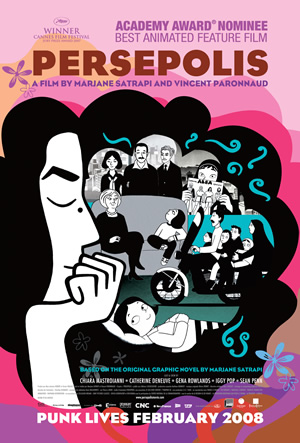
The flu is never fun, but it gave me a chance to catch Marjane Satrapi's autobiographical animated film, PERSEPOLIS. Fare warning: it's in (stunningly composed) black and white, animated in a limited way, to match the look of the GRAPHIC NOVEL on which it is based. It's in French, and if you don't know French, y' gotta read subtitles.
The film has many layers, and can be interpreted through many different frames of concern... it is a political film, a deeply personal narrative, a coming-of-age story, a "portrait of an artist as a young girl", a story of a family, a story of culture and identity. Unlike many films, there is not a "lens" that is a more or less valid, more or less true or more or less rewarding way of appreciating the film. Most films struggle to have one context or "idea", so that alone is a reason to recommend the film.
For "the Bettie Page Blog", while geopolitical interests are important, the film is mainly interesting as a statement on underwear. Who can have visible panty lines and who can't. Okay, that's glib -- it's also about lipstick.
The film begins with Marjane as a young girl, enduring the rise of Islamic Law in what was once a very Westernized (if repressively autocratic) Iran. While the Shah isn't sanitized, the politics of sexuality comes to the fore as women's right to exert their own femininity is robbed from them... for their own good. As the blog continues to examine the often strange line between empowerment and exploitation, looking at Marjane's amazing work through a pro-sex feminist worldview, it's easy to see how the religiously-motivated state in Iran robbed women of their right to be sexual beings, then robbed them of their voice in society. All of this was done based on the concept that men, being creatures of lust and rape, could not be trusted to view women as sexual beings. So, rather than force MEN to curb their behavior, WOMEN are required to go to ever-more draconian lengths to suppress their femininity.
In a crowning scene in the film, Marjane, now at "art school" (where women in hijab must draw a figure in hijab) mentions that the men have many choices of dress, and some even accidentally display their underwear! In this moment, not only does Marjane show the hypocrisy of the law, but also undermines the guiding assumption... that women do not have an innate sense of the erotic, so they do not need "protected" from arousal.
By showing herself to be a sexual being, willing to be desired and capable of desiring, she shows how vital sexual liberation is. In most Western countries, this is taken for granted, and mostly we hear the hew and cry of those oppressive elements in our own nations, wishing sexual liberation was reigned in. It almost makes sense... until a powerful story about total sexual oppression can show how devastating that loss can be on a psyche.
This certainly isn't meant to offend devout Muslims, but it was my honest reaction to this film. I certainly don't feel that the Muslim religion has a monopoly on oppressive elements. Furthermore, people should have the freedom to practice in a way that feels meaningful to them. In this film (and in many places on the globe), however, women are being forced to observe a religious dogma... and true faith should never be forced.
4.03.2009

I figure Bettie Page fans would also be Mae West fans, especially since Mae West dealt more directly and self-consciously with the issues of sexual equality and sexual power.
Here's what Simon & Schuster has to say about Charlotte Chandler's new bio, based on interviews conducted with Mae in the 80's:
And here's a review for Publishers Weekly:Actress, playwright, screenwriter, and iconic sex symbol Mae West was born in New York in 1893. She created a scandal -- and a sensation -- on Broadway with her play Sex in 1926. Convicted of obscenity, she was sentenced to ten days in prison. She went to jail a convict and emerged a star. Her next play, Diamond Lil, was a smash, and she would play the role of Diamond Lil in different variations for virtually her entire film career.
In Hollywood she played opposite George Raft, Cary Grant (in one of his first starring roles), and W. C. Fields, among others. She was the number one box-office attraction during the 1930s and saved Paramount Studios from bankruptcy. Her films included some notorious one-liners -- which she wrote herself -- that have become part of Hollywood lore: from "too much of a good thing can be wonderful" to "When I'm good, I'm very good. When I'm bad, I'm better." Her risqué remarks got her banned from radio for a dozen years, but behind the clever quips was Mae's deep desire, decades before the word "feminism" was in the news, to see women treated equally with men. She saw through the double standard of the time that permitted men to do things that women would be ruined for doing.
Her cause was sexual equality, and she was shrewd enough to know that it was perhaps the ultimate battleground, the most difficult cause of all. In addition to her extensive interviews of Mae West, Chandler also spoke with actors and directors who worked with and knew the star, the man with whom she lived for the last twenty-seven years of her life, as well as her closest assistant at the end of her life. Their comments and insights enrich this fascinating book. She Always Knew How captures the voice and spirit of this unique actress as no other biography ever has.
She Always Knew How: Mae West, a Personal Biography Charlotte Chandler. Simon & Schuster, $26 (336p) ISBN 978-1-4165-7909-0Sound familiar? Mae West definitely set the stage for Bettie Page. I think I'd like to learn more about her....West carefully constructed and guarded the image of her personality as a woman who enjoyed sex at a time when “skirts had to cover ankles.” She contended she was “never vulgar. The word for me was suggestive.”
4.01.2009
Save vs. Death: Rosie the Riveter's safety bra (1943)
0 comments Posted by Bettie Blogger at 10:33 PMSave vs. Death: Rosie the Riveter's safety bra (1943) More on Rosie -- her plastic "safety bra" in full effect!
Save vs. Death: the many faces of Rosie the Riveter (1941-1945)
2 comments Posted by Bettie Blogger at 10:31 PMSave vs. Death: the many faces of Rosie the Riveter (1941-1945)
From the same blog as the Carnival Girl, "Save vs. Death", please do yourself the favor of checking out the amazing "Many Faces of Rosie the Riveter" photo-essay.
Save vs. Death: at the state fair (1950)
Another Carnival Girl!


A recent trip to DISNEYLAND revealed an amazing number of retro-themed products. It seems our community has been discovered by the biggest media company in the world -- and judging from the number of Bettie Page bangs, pinned hair, pomps and the like walking through the place, it's no wonder. The fact that Pixar's John Lassiter has taken over as Principal Creative Advisor for Walt Disney Imagineering (among other jobs at the studio) has helped. Pixar, ironically, always seemed to "get" what Disney used to have and lost. So, with his ascendancy comes a renewed reverence for not only Disney's history (such as shifting California Adventure from a celebration of all things that yuppies love about Cali -- like expensive wine -- to an upcoming shift to a 1920's-themed part about how Walt experienced California when he first arrived) but retro pop culture in general. Pics above include lots of tiki-inspired fare and a tattoo-themed Mickey. At the very least it shows that someone else besides Christian Aguilera can make a tattoo-themed t-shirt!
More links showing Pixar's love of retro:
Wall-E teaser posters by Eric Tan
3.31.2009

Fan site PLANET BETTIE has a whole gallery of Bettie tattoos -- here's a few, go HERE to see the rest:
3.30.2009

The number one movie in the country is a cutting-edge, IMAX-worthy, 3-D, CGI fest that owes its existence to those who toiled in the margins of the film industry back in the day. While the film is funny and frenetic, it is also a great way to lend some contemporary relevance to the monster movies of the past (in an age-appropriate way, of course). Bettie Page used to love stories of the fantastic, and would regularly patronize double-features in Times Square. For generations after, UHF channels were bastions of monsters and horrors on Saturdays after the cartoons ended. Now, while we live in an age where everything is "available", the classic monsters of yore are rarely actually on the TV... you need to hunt them down and bring 'em home.
So, log on to Netflix or run to Blockbuster and treat the family to a "Monsters Who Inspired Monsters Vs. Aliens" film festival in your house! Use this mass-market media blitz to show those near and dear to you that teeny tiny budgets can also have a big impact on viewers' imaginations!
CREATIVE LOAFING gives you the complete run-down on the original monster movies that inspired the characters in Monsters Vs. Aliens:
THE ATTACK OF THE 50 FOOT WOMAN
THE BLOB
THE CREATURE FROM THE BLACK LAGOON
THE FLY
and
MOTHRA

3.27.2009

Remember that "sick of doing tribute posts" post a while back? Well, Forrest Ackerman's death, in the wake of Bettie's, was another one of those losses that was difficult to reflect upon in a tidy, snappy way. For generations upon generations, Forrest Ackerman WAS "fandom". The internet and all of the millions upon millions of blogs, forum arguments, flame wars, fan fiction... generally obsessing over imaginary realms as if they were real... are the product of Forrest J. Ackerman. Forrest was an agent, a producer, a publisher and a writer... but, in reality, he was a professional cheerleader for others, a professional booster of all things fantastical, be it conveyed through the written word, film, TV, magazines, comics or paintings. He published a magazine that is imprinted in the DNA of the "boomer" generation in a way that we, having benefited from more options in reading material, can't quite comprehend. The dude created the term "Sci Fi" (which old-school hardliners thought cheapened the genre and NBC/Universal/GE/Mom's Old Fashioned Robot Oil has just mutated into "Sy Fy".) Like Walt Disney, Forrest Ackerman created an amusement park... but his existed in our ever-expanding collective imagination. His gift to those who read and dream is incalculable... and it continues to grow, even as the memories of the man who's most responsible for fandom will fade. Spielberg, Lucas, the whole "Masters of Horror" gang, all were raised on Ackerman's unique take on the fantastict... a little fright mixed with a ton of fun. Now, artists as diverse as Joss Whedon to Zack Snyder to Rob Zombie owe their cross-platform mythologizing to Ackerman. And the AIN'T IT COOLs and the like flat out wouldn't exist without him. His irrepressible love of imaginative fiction, seen as fish wrap in his childhood, has created a society that, upon his death, views the fandom he organized and fostered, as the pillar of the multi-billion-dollar, global entertainment industry.
Which is all a way of teeing up Mike Richardson (that's Mr. Dark Horse Entertainment to you, pal) and John "Blues Brothers" "An American Werewolf in London" "Thriller" "Master of Horror" Landis' tributes to Ackerman.
(Free plug for Landis: His recent documentaries are amazing. Rent SLASHER about an alcoholic used car salesman, a dark-comic masterpiece, and watch his new documentary about Don Rickles, MR. WARMTH on HBO.)
Mike Richardson and John Landis on Forrest Ackerman 3/25/09
On Sunday, March 8, a tribute was held for Forrest J Ackerman. I, like many others, have stories to tell about the influence "Forry's" magazine, Famous Monsters of Filmland, had on me as a youngster. It seems like only yesterday that my fifth-grade teacher, a nun, sent me home from school after she caught me carrying an issue (the one with King Kong on the cover) into class. Unlike John's parents in the tribute below, my mother simply asked me not to bring the magazine to school again.
I met Forry at the Ackermansion with artist Geof Darrow, in the first of several visits. He knew of Dark Horse at the time and was eager to be put on the comp list, something in which I was happy (and honored) to oblige him.
I saw Forry off and on for years. He was a special guest at a number of events I attended, including the grand opening of our Things From Another World store on Universal Studio's Citywalk. I always found him to be a gentleman and extremely gracious with his time. I last visited him a year or so ago at the Acker-mini-mansion with my friend John Landis. It was clear that Forry was not feeling well and I wasn't sure he even recognized me, but we had a great time talking about the magazine, the memorabilia located throughout his home, and, of course, movies. I'm sure that many shared my own feeling that a bit of my own life passed with him.
John Landis was a good friend of Forry's, and what follows is a shortened version of the tribute he delivered at the memorial service:
Like most of the people in this theater, when I was a kid I loved Famous Monsters of Filmland.
However, once my mother saw a photograph of a woman with an ax in her head in the magazine, my pile of issues was thrown out, and Famous Monsters of Filmland was banned from the house.
All was not lost though, because my cousin Scott subscribed and I could read them at his house.
The same way the original King Kong lit a flame in the young Ray Harryhausen in 1933, The Seventh Voyage of Sinbad was the young John Landis's career epiphany in 1958.
When I was twelve years old, I wrote a fan letter to Harryhausen and mailed it care of Forrest J Ackerman at Famous Monsters of Filmland.
Forry actually forwarded the letter on to Ray in London and Ray sent me an autographed eight by ten glossy of him animating the dragon from The Seventh Voyage of Sinbad -- which is still framed and proudly displayed on the wall of my library at home.
In 1971 I wrote and directed my first feature film, the appropriately titled Schlock.
This sixty-thousand-dollar effort is most notable for two things: it was my first collaboration with the young makeup artist Rick Baker, and it is the reason I met Forrest J Ackerman as they say, "in the flesh."
Schlock's cast and crew screening was held at the Cary Grant Theater at MGM Studios in Culver City. Exactly how Forry got there I don't know, but after the screening he introduced himself to me in the parking lot in front of the Thalberg Building and also introduced the fellow he came with, Ed Wood!
Mr. Wood was absolutely astonished that I knew who he was and of the movies he had made. He was a sad shabby guy whose breath reeked of alcohol.
But Mr. Ackerman was more than gracious and not only invited Rick Baker and I to the Ackermansion, but kept his promise of publishing photos and an article on Schlock in his magazine, Famous Monsters of Filmland. And this was a year before we managed to get a distributor!
The Ackermansion was then on Olympic Boulevard near La Cienega, walking distance to the Ships Coffee Shop, another Los Angeles landmark no longer with us.
Others today will speak of Forry's legendary accomplishments, his magazines, his influence on generations of writers and filmmakers, his extraordinary generosity, his countless viewing of Fritz Lang's Metropolis, his Al Jolson imitation and his mad crush on Marlene Dietrich, his time at nudist colonies, and his knowledge of Esperanto, his wide circle of friends, clients, enemies, admirers, acolytes and parasites.
For me Forry was a loyal and staunch friend and of course a fine actor in many of my films.
His patient and loving wife Wendy liked to recall the night that one of Forry's pulp author clients, L. Ron Hubbard, had them and a few others, over to his apartment to pitch a new religion he invented called Scientology.
Hubbard promised that it would make everyone assembled very rich, and Forry couldn't get out of there fast enough. Wendy appreciated her husband's integrity, but as she told me, "I always secretly regretted not getting in on the ground floor of that epic scam."
The Ackermansion duplex on Olympic moved to the Ackermansion in Horrorwood, Karloffornia, in that big house that once belonged to actor Jon Hall.
And finally to the classic small Hollywood bungalow where he held court in the Acker-mini-mansion where he ended his days. All places I remember with great affection. All places he opened to one and all for anyone to visit his treasures.
The motion-picture industry, the movie business, has always treated the ephemera of filmmaking as industrial waste. It is only because of fringe enthusiasts like Forrest J Ackerman, Bob Burns and Henri Langlois that many iconic props, costumes and manuscripts pertaining to film production exist at all. Yet another way Forry has blessed us.
My daughter Rachel still has the beautiful antique porcelain doll that Forry gave to her as a child after Wendy passed away. It was a prized possession of Wendy's and is beautifully dressed and carries a purse. Rachel immediately named her Wendy and discovered that Forry had put a silver dollar in that purse.
And when my then-ten-year-old son Max told him he wanted to read some science fiction, Forry sent over a cardboard box full of Robert Heinlein and Ray Bradbury paperback books. And I am proud to tell you that Max now makes a living as a writer.
And every year like clockwork, Forry would call my wife Deborah to wish her a happy Mother's Day.
Forry's embrace of Esperanto is typical of the true futurist and idealistic man he was.
Although he was extremely ill he told me he could not die until he voted for Obama for president and he did.
Forrest J Ackerman was a unique person, whose generosity touched us all. We are all better for having had Forry in our lives. I know I am.
 |  |
It's TAP WEEK, when UNICEF tries to focus our attention on that stuff you mix with Scotch... well, it doesn't come outt a tap for everyone. (For the record, Bettie never drank, so please don't mix your water with Scotch... but we won't tell if you do ~ ed.) I know some folks think the UN are the sign of the End Times, but even if they're right, UNICEF is consistently rated as one of the most effective and efficient charities out there, helping kids in dire need both here in the US and abroad.
Reflecting the hard economic times, UNICEF is starting a new way to "donate" to the Tap Project fund... sell your crap on eBay! Click HERE to learn how you can empty your garage or that overstuffed closet and channel a PORTION of the proceeds that YOU determine to help SAVE KIDS LIVES. Pretty cool, huh?
If you have nothing to sell, check out what others have put up and BUY something.
Remember that Bettie Page was once so poor as a child, her mom put her in an orphanage for a few years until sewing and laundry work gave her mom enough money to feed Bettie... so, do it for her!
Pass this around the whole retro community... the more people who put cool stuff up (dresses, shoes, magazines, CDs, etc.), the more in our community will have to BUY!

Sadly, we missed this show, but in early February, Hyaena, an "outsider" art gallery in Burbank, CA, hosted a Bettie Page Tribute group show. We loved what they had to say in the program for the show:
Bettie Page, the Queen of Pin-Ups passed away late last year, leaving millions of fans to mourn the loss of one of the world’s greatest beauties. In life, Bettie was the epitome of what this gallery represents. She pushed boundaries in a conservative society and was at the front lines of controversy. Censorship, sexuality…she broke ground in these areas and inspired generations with her strength, courage and pride.Dienzo's piece caught our eye for the dark whimsy in his work. We weren't shocked to learn he has spent time in the commercial world, working at CARTOON NETWORK, as his pieces have a very clean, bold sense of design. His work, true to the Pop Art aesthetic that informs it, conjures a host of feelings but, on inspection, isn't derivitive of any other artist. Sure, the goth-kawaii noodling of Tim Burton spring to mind, as does Burton's inspirations, Gahan Wilson, Edward Gorey and Charles Addams. However, just as strongly felt is the detrus of a 70's childhood... FAMOUS MONSTERS OF FILMLAND covers, snap-together model kits and other pieces of nightmarish painted commerce. Like animation, paintings like Dienzo's can seem "simple", but few things are conceptually more challenging than designing and executing such graphicially concise characters with and abundance of what the Disney masters used to call "appeal".
Nowhere has this loss been felt so heavily as in the Art World. From Dave Stevens to Olivia and countless other fine, outsider, and lowbrow artists, her image has touched men and women alike. Her face alone invokes mystery and duality…a purity and naughtiness that beckons us all. Bettie Page is permanently ingrained in our pop culture and in our hearts. This tribute show is a celebration of her legacy and her continued inspiration.
When asked by the Bettie Page Blog to illuminate us as to his thought process, Dienzo explained his facination with the duality between light and dark, good and evil, tying it into the core of Bettie Page's appeal:
"I've deliberately chosen to juxtapose the dark and light aspects of each character throughout my work. Be it literally in the form of childlike zombies and vampires, or by thematic tones of darkness saved by innocence - like cute female assassins.
Bettie Page has served to inspire me not only from a surface level of aesthetic beauty, but also from that same endearing quality of being an "innocent-provocateur." Her iconic presence permeates so many sub-genres of art, music and culture that being influenced by her is almost entirely unavoidable.
I created three Bettie inspired pieces to capture different aspects of the woman we've come to admire.
   | "Bettie Whipping" is indicative of her risque, bondage era photography. It shows her as powerful woman in control with the sharp contrast of black and yellow reinforcing the impactful nature of that style. "Bettie Purring" is meant to show her as the quintessential vixen. An object of desire with the leopard print and warm tones evoking primal instincts of attraction. And finally, "Bettie Dreaming" is meant to capture her underlying innocence and naivete. Throughout her life she struggled with reconciling her own morality against public perception and that inner goodness is part of what made her so appealing as a "girl next door." I also thought it fitting to immortalize her with eyes closed and forever dreaming, given her recent passing. |
I hope these pieces serve to honor her and inspire others to keep her legacy alive."
Rick "DIENZO" Blanco's work can next be seen publicly at Fangoria's Weekend of Horrors.


3.26.2009


David Downton is a world-renowned fashion illustrator known for his portraits of model Erin O'Connor and burlesque performer Dita Von Teese (www.daviddownton.com). Downton is also the founder and publisher of Pourquoi Pas? A Journal of Fashion Illustration (www.pqpmagazine.com). His recent work was included in Victoria and Albert Museum exhibitions and their 150th Anniversary album; on the cover of 100 Years of Fashion Illustration by Cally Blackman; at stores including Browns, Harrods, Harvey Nichols, Marks & Spencer, Saks Fifth Avenue, Selfridges, Tiffany & Co. and Topshop; in magazines such as Elle, Harper's Bazaar, Harpers & Queen, L'Officiel, Tatler and Vogue; publicity material for the British Academy Film Awards; and costume drawings of Cate Blanchett as Elizabeth I for Universal Pictures.
Also, ever wonder how Dita can get all those beautiful clothes off her body so easily? I bet the boys have ;) CHIC IN PARIS, an oh-so-haute fashion blog gets the lowdown on the designers and specifications of Dita's costumes for her celebrated CRAZY HORSE shows.


Dita Von Teese Strips Down To Fox Fur
The PETA campaigner contradicts herself by wearing animal skin...
Animal lover Dita Von Teese has stripped down for a sexy shoot - wearing fox fur.
The burlesque star - who appears in PETA's Animal Birth Control campaign - strikes a seductive topless pose on the cover of tattoo magazine Inked, with only a strategically-placed open jacket and red fox skin to cover her assets.
But apparently the animal rights organisation - who is known to target celebrities for wearing animal skins - know about her fur passion.
"PETA's totally aware of me. I'm not working with PETA to tell people to be vegetarians or to stop wearing fur. I am there to strictly speak about spaying and neutering your pets," Dita explained to People.
PETA Spokesman Michael McGraw says the group has not yet asked Dita to stop wearing fur, but might "possibly" have that discussion in the future.
"We're happy to have her support on that issue (spay/neutering), and we'll see where it goes," says McGraw.
Lulu Guinness, designer worn by Dita, interviewed.
Virginia may be for lovers, but is it too shy for burlesque?
A profile of UK performer Roxy Velvet in the University of York's student paper/website, NOUSE.
Bettie Page YouTube videos inspires Bryn Mawr students to start their own burlesque troupes and create a theater, according to The Bi-College News Online.
A profile of Glasgow's Club Noir (with video).
The Canberra Times talks to "The Burlesque Hour".
Miss Marion is an accomplished visual artist and burlesque performer showing her paintings and some skin in Paris.
The Guardian discusses The Ministry of Burlesque.
Dr. Sketchy's Art Club from nick lucchesi on Vimeo.
Video of St. Louis' Dr. Sketchy's Art Club.
Photos and video of the Dallas Burlesque Festival.
Headline: Burlesque Blossoms as Economy Crumbles.
More MINSKY'S links:
Variety
LA Weekly
Los Angeles Downtown News
Pasadena Star-News
Santa Monica Mirror
Ventura County Star
In the film, HEART LIKE A WHEEL, audiences saw what "women drivers" could really do -- win races and take trophies away from the "good ol' boys"! Now, HOT ROD MAGAZINE lets the Queen Of Drag Racing, Shirley Muldowney, speak for herself!

Burlesque artist Immodesty Blaize has written a novel set in the world of burlesque, entitled TEASE. Evidently, such a glamorous performer isn't the norm at gatherings of literary types, as her upcoming reading and striptease at Hay-on-Wye has tongues wagging.
FILM THREAT reviews the indie movie HOT ROD GIRLS SAVE THE WORLD.
3.25.2009
...in Louisiana's The Advocate/Channel 2 website.


The NAKED FOLK CALENDAR (pictured above) helps pay for the health care of uninsured or underinsured folk musicians.
The GLAM BLOG has pictures of a great Brazilian retro-pin-up calendar, Contigo!
In the early 50’s famed artist George Petty drew and airbrushed the pin-up girls for Ridgid Tools popular calendars... PLANETZMAN has a gallery (the overall site seems neanderthal-ish, but the Petty pics are priceless.)
We have a crush on BOMBSHELL STAMPS, as they allow for some seriously sexy scrapbooking.
TRENDHUNTER has deemed retro pin-ups "playful"... so I guess it's okay to like it now! (Let me know when it's not "trendy" and then I'll make sure to hate pin-ups and, in fact, deny ever having liked them!)
“My inspiration to create the Female Mechanics Calendars came from my experience working as a carpenter and as a motorcycle mechanic in shops where I often felt like an anomaly for being a woman. I feel that it is so important for people to see that there are women who actually work these jobs, and can thrive if given the opportunity to learn. I am continually inspired by the people I have met while creating this project.” ~ Sarah Lyon, creator of the Female Mechanics Calendars, which, true to its name, features verite shots of women automobile, motorcycle,
jet aircraft, bicycle, hot rod, race car, hybrid, and diesel mechanics
from around the country. (hat tip: Feminist Philosophers)
3.24.2009
While horror gets lots of mainstream attention for celebrating sexualized violence towards women, a new documentary, PRETTY BLOODY shows that women have been a powerful force in the industry at every level. CLICK to see an interview with Jovanka Vuckovic (of Rue Morgue) discussing the doc and women in horror in general. Supposedly, it spends a lot of time on Vampira, which has us drooling to see it.
ANDRÉS SARDÁ CIBELES MADRID FASHION WEEK 2009
And a DEAR ABBY reader wants everyone to wear panties like Bettie Page... just like his sisters used to... um, ew!

The Rape Crisis & Sexual Abuse Centre, which provides counselling and support to the survivors of sex attacks, has come under fire for using a near-naked dancer (burlesque performer Amber Topaz, pictured above ~ ed.) as part of its line up for a fundraising concert to mark International Women's Day. READ THE REST and read a SECOND ARTICLE and a THIRD ARTICLE -- what do you think?
MANDOM MAGAZINE interviews THE BROWN BETTIES
Check out the SEX WORKERS ART SHOW, currently featuring burlesque luminaries Simone De La Getto, Jo Weldon, World Famous "BOB"
Interesting interview with Toronto performer Sasha Von Bon Bon in the PINK TRIANGLE PRESS.
AMISH BURLESQUE: "The opening number is a striptease where the only thing removed is a sock in about five minutes," says producer Marty Schiff... READ MORE
Cool interview with Oxford performer Tempest Rose by the OXFORD MAIL.
EXAMINER review of MINKSY'S, a musical set in the world of early Burlesque. Previewing in Los Angeles, the show is bound for Broadway. Good ol' Wikipedia fills in the history of the show, which was developed from the 1968 feature, THE NIGHT THEY RAIDED MINSKY'S, which, in turn, was inspired by true events. LA OBSERVED spotlights the musical as well. NPR talked to George Wendt, one of the stars of the show.
The Los Angeles Times profiles Betty Rowland, an original 'Minsky's' girl. The former burlesque dancer, 93, describes a tough but rewarding experience performing during the Depression.
Australian Stage interviews Ali McGregor about the connections between stand-up comedy, burlesque, cabaret and opera.
"Teasy Does It" -- an article in NZ Herald News about New Zealand's Hootchy Kootchy Girls expands into a general article about the development of neo-burlesque.
Daily Free Press profile of the Boston Baby Dolls.
A BroadwayWorld.com article on Denver's Black Box Burlesque: For the first time since the 1930's a theatre is being built specifically to house burlesque, headed up by Reyna Von Vett of last fall's acclaimed Leadville or Bust.
NY Daily News introduces us to Stiletto Spy School.
Des McAnuff explains why there are now burlesque dancers in his reinvention/revival of GUYS AND DOLLS, currently on Broadway. "Miss Adelaide keeps telling us that she has a chronic cold because of her skin exposure," McAnuff laughs, "and that makes a lot more sense if she's a burlesque stripper than a nightclub dancer."
Grand Rapids performer, the hula-hooping burlesque dancer named "Vivacious Miss Audacious", is interviewed by her father's (uncomfortable) co-worker.
Review of the burlesque-themed "mocumentary" TUMBLING AFTER.
TIMES ONLINE uncovers DIY Lingerie.

Talk about standing behind your work! Gavin Hignight, the creator and writer of the superantural/rockabilly graphic novel MOTOR CITY now sports a fresh tattoo of the book's comely character, "SAM"... in a Bettie Page-inspired pin-up originally drawn by the book's illustrator, Jetilla Lewis.
Gavin tells us, "I got that Tattoo from Hanah Aitchison, on the TV show LA Ink, but I'm not sure if the episode will air or not this season. Her work is freaking incredible though."
For more info on MOTOR CITY:
www.gavinhignight.com
www.motorcitycomic.com


